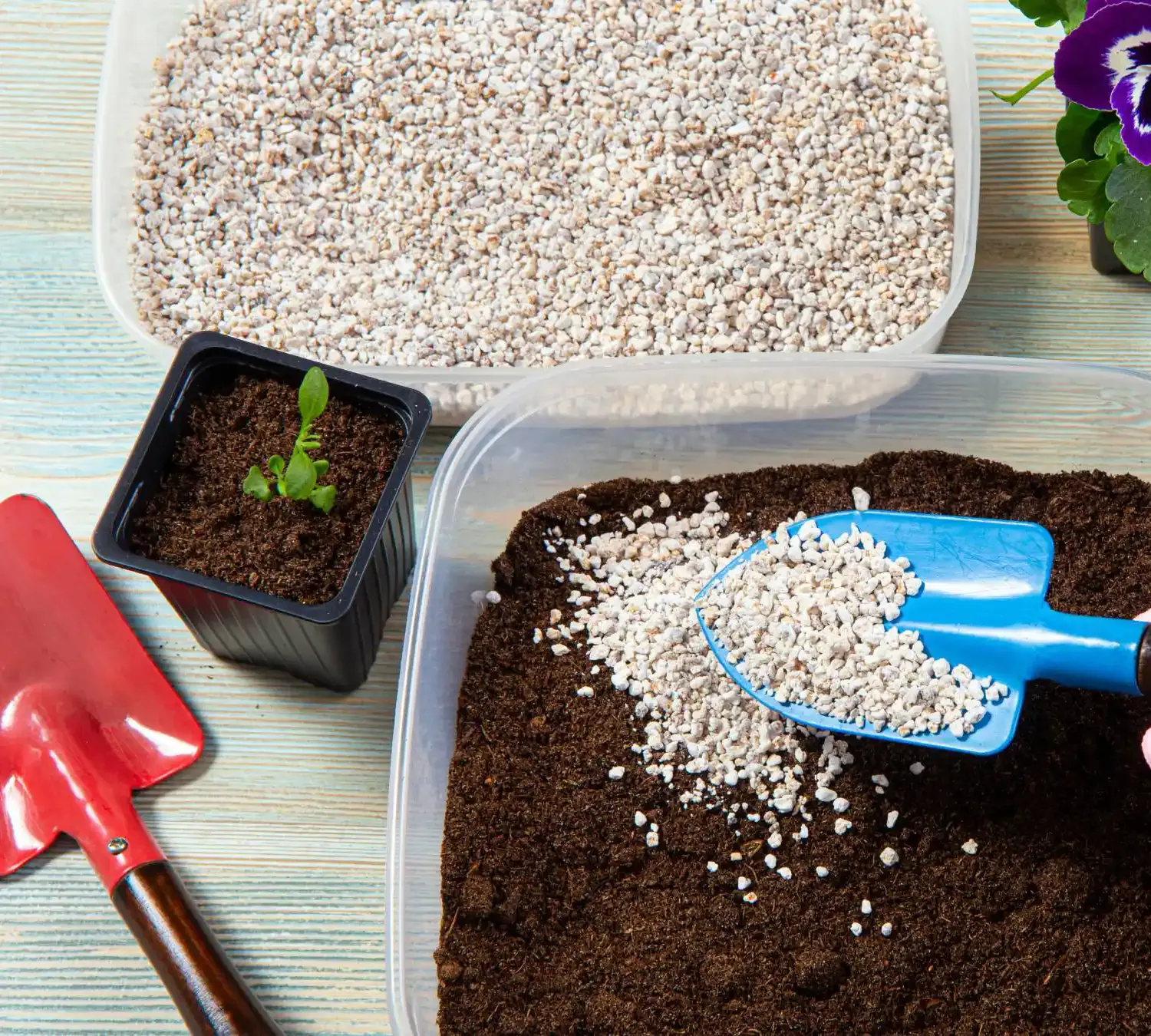
In short: Perlite is a natural volcanic glass that is puffed up like popcorn by heating it to 850–1200 °C. The white, very light granulate makes potting compost loose and airy, is pH-neutral, free of nutrients, sterile as it leaves the factory and does not rot. In the garden it is usually mixed into potting compost at 10–30%.
From volcano to flowerpot
Perlite begins as lava. When silica-rich (rhyolitic) lava cools quickly, it does not solidify into crystals but into volcanic glass. If this glass absorbs water over a very long time, it becomes perlite rock: a stone with about 3–5% chemically bound water. Glass with less water is called obsidian, and glass with more is called pitchstone.
This raw rock is quarried in open-pit mines, crushed and sieved. The decisive step then takes place in the expansion furnace: the grains are heated suddenly to around 850–1200 °C. The glass softens, the trapped water turns to steam and puffs up each grain from the inside. The volume increases about tenfold, and up to twentyfold depending on the raw material.
What comes out of the furnace is the perlite you know from garden centres: white, irregular grains that weigh almost nothing. Around 97% of their volume is made up of pores and gaps.
Perlite or perlit? Both spellings mean the same thing. “Perlit” is the German form and “perlite” the international one, which has become standard in the trade.
Where perlite comes from
According to the U.S. Geological Survey, around 4.6 million tonnes of perlite were mined worldwide in 2025. The largest producers are China (about 1.5 million t), Turkey (1.4 million t), Greece (840,000 t) and the USA (460,000 t); together they account for over 90% of world production. Smaller quantities come from Hungary, Iran and Slovakia, among others. Greece and Turkey are the most important exporting countries.
In the USA, about 15% of expanded perlite goes into horticulture. Most of it is used in building materials, for example as loose-fill insulation or in lightweight plasters, and a further share serves as a filter aid.
Key properties at a glance
| Property | Typical value | What it means in the garden |
|---|---|---|
| Bulk density | approx. 96–128 kg/m³ | a 100-litre bag weighs only about 10–13 kg |
| Total pore space | approx. 97% by volume | plenty of room for air and water |
| Water-holding capacity | approx. 19–52% by volume, depending on grain size | fine grades hold more water, coarse grades more air |
| pH | neutral, approx. 6.5–8.0 | does not change the soil pH |
| Nutrients | practically none | fertilising stays in your hands |
| Cation exchange capacity | very low (approx. 1.5 meq/100 g) | hardly stores any nutrients |
| Hygiene | sterile as supplied | suitable for seed starting and cuttings |
| Durability | does not rot | keeps its shape for years |
Chemically, perlite consists of about 70–76% silicon dioxide and 11–18% aluminium oxide, plus potassium and sodium oxides. Important: the silicon dioxide is mostly amorphous, in other words glassy; safety data sheets give a crystalline quartz content of less than 1%.
How perlite works in the soil
Perlite improves only the structure of the soil. The hard, irregular grains stop the soil from settling over time. Large pores stay open between the grains, letting excess water drain away and air flow in. Roots need oxygen; in compacted, wet soil they suffocate and start to rot.
At the same time, perlite holds water, mainly on its rugged surface and in the gaps between grains. How much depends strongly on the grain size: according to measurements by LSU AgCenter, very coarse perlite holds about 19% of its volume in water, fine perlite around 52%. The rule of thumb is therefore: the finer the grade, the more water; the coarser, the more air.
Because perlite contains no nutrients, stores none to speak of and does not affect the pH, the chemistry of your soil stays the same. That is an advantage for seed starting and for hydroponics, where the nutrient supply is tightly controlled. It also means that plants in pure perlite need fertiliser from the very beginning.
What you can use perlite for
- Houseplants and balcony plants: 10–30% perlite in the compost, usually about 20%.
- Seed starting and sowing: 20–30% fine perlite in seed compost.
- Cuttings: pure perlite, or 1:1 with seed compost or coir.
- Cacti and succulents: part of a mineral share of 30–50%.
- Raised beds, planters and heavy soils: about 20% in containers, roughly 10 litres per m² in clay beds.
- Hydroponics: pure or mixed with coir.
You will find the exact ratios in our guide How to mix perlite with soil.
Is perlite safe?
In manufacturers’ safety data sheets, expanded perlite is not classified as a hazardous substance under the European CLP Regulation. There is one practical point, though: the dry granulate is dusty, and fine dust can irritate the eyes and airways. So dampen perlite before handling it, work outdoors if you can, and wear a dust mask with a P2 or FFP2 filter for larger quantities. In Switzerland, the general Suva workplace limit for such non-specific dusts is 3 mg/m³ (respirable) or 10 mg/m³ (inhalable) – in a hobby garden these simple measures keep you well below it, but it is still worth not stirring up dust in the first place.
How sustainable is perlite?
An honest answer has two sides.
In its favour: Perlite is a natural rock; pure horticultural perlite contains no chemical additives (some commercial products are mixed with fertiliser or wetting agents – it pays to check the label). It does not rot, stays effective for years and can be reused after rinsing. And it helps with going peat-free: in Switzerland peat extraction has been banned since 1987, yet according to the Federal Office for the Environment more than 500,000 m³ of peat are still imported every year. The federal government wants to reduce this consumption. Peat-free composts need structural ingredients, and perlite is one of the most common – including in peat-free growing media listed in the FiBL input list for Swiss organic farming.
Against it: Perlite is a mined, non-renewable raw material. Expanding it at over 850 °C takes energy. Industry figures from the Perlite Institute for insulation perlite give around 0.52 kg CO₂ equivalent per kilogram of expanded perlite, which is about 60 kg per cubic metre. Transport from the mining countries adds to this.
Our conclusion: perlite is not a “green miracle cure”, but it is a long-lasting material that can have a good footprint when it is used sparingly and reused several times. The best environmental measure is to use only as much as the plant really needs, and to reuse perlite you have already used.
Perlite and its alternatives
Perlite is not the only mineral material for loose soil. Vermiculite stores more water and nutrients, expanded clay (LECA) is coarse and ideal for hydroponics and drainage, and pumice and lava rock are heavier and particularly stable in structure. Our comparison of perlite, vermiculite, expanded clay and pumice shows which material suits which job.
Perlite for your garden
Would you like to try perlite, or do you need a larger quantity? At ACAR Gartenbedarf in Basel we are happy to advise you on the right grain size and send you a no-obligation quote. You can find more about our product on the perlite page, and you can send an enquiry directly via the contact form.
Frequently asked questions on this topic
What is perlite?
Perlite is a natural volcanic glass that is heated suddenly to around 850–1200 °C. The water trapped inside turns to steam, each grain swells to roughly ten times its size, and the result is a white, porous and very light granulate.
What is perlite used for in the garden?
Mainly to keep potting compost loose and airy: perlite prevents compaction and waterlogging while still holding some water. Typical rates are 10–30% in potting mix, and pure perlite for cuttings and hydroponics.
Is perlite a natural product?
Yes. Perlite is a natural rock that is simply crushed and expanded by heat. It is, however, a mined, non-renewable raw material, and expanding it takes energy.
Does perlite break down over time?
No. Perlite is mineral and does not rot. It keeps its shape for years and can be reused after rinsing.
Sources
- U.S. Geological Survey: Mineral Commodity Summaries 2026 – Perlite (opens in a new window)
- Industrieverband Garten (IVG): Substratbuch – Blähperlite (opens in a new window)
- USDA AMS / OMRI: Technical Report Perlite (2024) (opens in a new window)
- LSU AgCenter: Growing Media for Containers, Part 2 – The Inorganics (opens in a new window)
- Perlite Institute: Perlite – the most sustainable insulation solution for buildings (opens in a new window)
- BAFU: Torf (opens in a new window)
- FiBL: Betriebsmittelliste 2026, Ausgabe Schweiz (opens in a new window)